Monitoring Reports about the Greek Community in Turkey
Click here to download the Monitoring Reports.
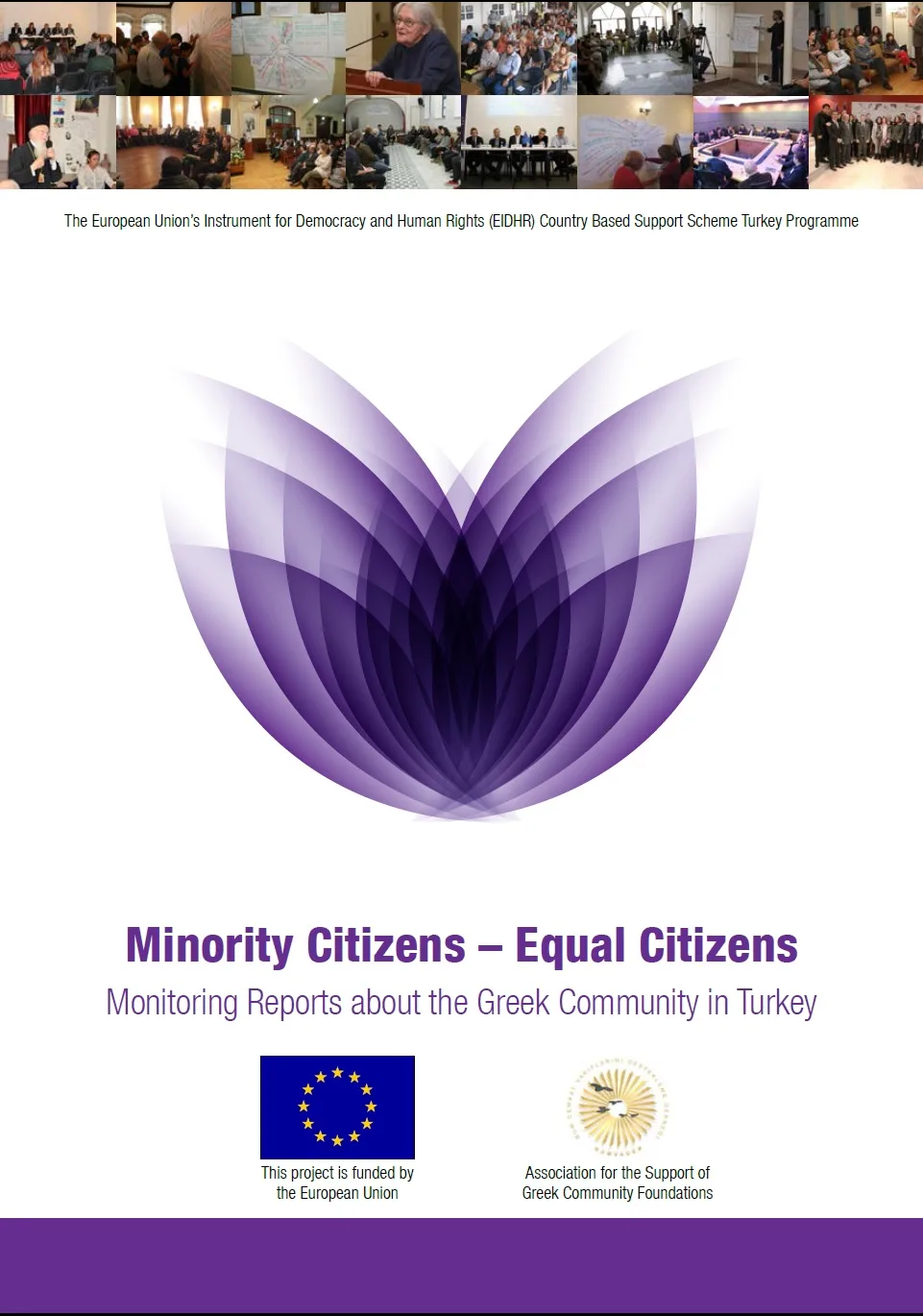
The present publication takes place in the framework of the European Project entitled «Minority Citizens-Equal Citizens» that was implemented by the Association for the Support of Greek Community Foundations (RUMVADER) from December 2012 to February 2015. To be noted that the Ecumenical Federation of Constantinopolitans (E.FE.CON.) also participated as a partner in the Project.
The publication includes monitoring reports on the Greek minority in Turkey, outlining the present situation of the Community, without any effort to embellish it, while also expressing publicly its concerns. At the same time, these texts propose recommendations on the chronic problems of the minority addressing authorities and institutions as well as the internal part of the Community itself. These reports represent the first systematic attempt of the Community itself to record and highlight the issues that have resulted in the deprivation of the full enjoyment of the rights of an equal citizen by its members. Therefore, the said reports are an important tool for bringing these problems to the attention of the general public on behalf of the Community (the reports were published in three different languages, Greek, Turkish and English).
The five thematic reports were selected by the Project Steering Committee in consultation with partners and stakeholders, taking into account the objectives of this project and based also on the following criteria: i) to include all groups that exist within the Community, ii) to touch on the thorniest problems and iii) to highlight proposals and document solutions for the above.
More specifically, the five reports are signed by an equal number of individuals and organizations representing the Community. The first report, signed by the prominent professor with a profound knowledge of Greek community issues, Mr. Konstantinos Tsitselikis, analyzes the operation and role of the community foundations, which constitute the only recognized legal entity of the minority according to Turkish law.
The second one, written by the scholar and historian, Mr. Nikos Sigalas, who has lived for more than a decade closely to the Greek community, analyzes the progressive de-politicization of communities, from 1923 onwards, which contributed to the gradual marginalization of minority citizens in Turkey from the decision-making centers at both local and national level.
Finally, the remaining three reports aim at a comprehensive narrative and analysis of the problems facing specific groups, which represent an integral part of the Greek community’s backbone, i.e., those of Imvros (Gökçeada) and Tenedos (Bozcaada), the expatriate Constantinopolitans and the Orthodox Christians of Antakya. These groups were originally set as target groups of the present program.
As stated above, the present publication is formally encompassed in the objectives of the European project entitled "Minority Citizens-Equal Citizens."
The key objective of the project activities from the very outset was to encourage and support the Greek-Orthodox community so as to enhance its self-esteem and its capacity to express itself coherently, constructively and effectively in political processes at every level.
More than forty events, seminars, meetings and conference sessions were held during the project’s implementation reaching out to over a thousand people, both members of the Community and members of other minorities as well as the wider Turkish society. Highly circulated newspapers presented very often the project activities while reflecting the views of community members in an objective and meaningful way. Moreover, the social media presence of the Community as a whole has considerably increased enhancing thus its interaction with the wider Turkish public opinion and contributing to its opening up to the broader social context. The creation of communication channels and the promotion of collaboration with civil society groups and non-governmental organizations have also been remarkable.
In this regard, on an internal level, the «Minority Citizens-Equal Citizens» Project provided the opportunity to strengthen the internal bonds of the Community with the community groups of Imvros (Gökçeada), Tenedos (Bozcaada), Antakya and the community of Constantinopolitans abroad, hence confirming the cohesion, solidarity and unity among its members. Equally important was the know-how acquired by the Association for the Support of Greek Community Foundations (RUMVADER) which is the sole coordinating body of community activities, in implementing initiatives aimed at mobilizing its members over the challenges currently facing the minority.
To this end, the implementation of the project was multi-faceted with multiple benefits in different fields. Targeted actions addressing community members intended to regenerate their interest to participate in community affairs, institutions and group activities while enhancing the climate of dialogue and inclusiveness. Furthermore, these activities which aimed at reflecting on the concepts of democracy, transparency, accountability and participation in the community, away from dividing lines and categorizations, pave the way for a broader reflection on how the Community itself can envision the future and on how to establish a common framework for a relevant discussion. Lastly, both the development of specific skills related to citizenship and sound management and the presentation of best practices from Turkey and other communities like the Jewish community, are an important legacy and inspiration for the years to come.
The project, also, initiated the mapping and privileged the involvement in community activities of the younger, vigorous generation of the Greek minority. It also helped to open contact channels and introduce to the Community Greek nationals who have moved to Istanbul in recent years, many establishing themselves in the country and acquiring not only professional, but also personal and family ties in this country.
All the above results and findings will be evaluated and will remain as a legacy to RUMVADER, so that they can be analyzed and endorsed in support of reforming community structures in the next years. Apart from the directly measurable quantitative variables of the project’s activities, the nature and character of these activities bring more long-term outcomes. The seed fell on fertile ground and with the necessary sense of purpose and with constant effort by the community members it will grow and bear the expected fruits.
During the implementation of this project, RUΜVADER found many allies both inside and outside the Community to whom warm thanks are extended.
First of all, the undivided support to this effort by His All-Holiness the Ecumenical Patriarch Bartholomew was of utmost importance for the impact and success of the project, encouraging us spiritually as well as supporting us with His presence in many of the activities.
The staff of the European Union Delegation in Ankara, and particularly Ms. Sema Kiliçer, was the first who shared with us the conviction that such a project would benefit the Minority and supported us strongly since 2011, when the first application was lodged, and throughout the phases for the completion of the project up until 2015.
From the outset, distinguished personalities and actors supported the effort of the Community to act as a collective subject with an equal and dynamic role in the civil society, while some of them participated in the Advisory Committee of the program as well. The Committee comprised, from the very beginning, the trainers Selen Lermioğlu and Yiğit Aksakoğlu, the Secretary General of TÜSEV (Third Sector Foundation of Turkey), Mr. Başak Ersen, the President of the Anadolu Kültür nonprofit cultural institution, Mr. Osman Kavala, Ms. Nora Mildanoglu on the account of the Hrant Dink Foundation, the Jewish Community and its Vice-President Mr. Moris Levi, the Advisor of TESEV (Turkish Economic and Social Studies Foundation), Mr. Etyen Mahçupyan, Ms. Mine Yıldırım on behalf of the Protestant Church, the President of the Federation of Alevi Foundations (AVF), Mr. Dogan Bermek, as well as the organizations “Helsinki Citizens' Assembly” and “Society Volunteers Foundation". Finally, members of the Committee were also Nadire Mater and Nilay Vardar as representatives of the independent news agency Bianet. Very supportive to our work were also all minority newspapers like Agos (Armenian newspaper published in Turkish) Şalom (Jewish newspaper), Jamanak (Armenian newspaper published in Armenian) as well as the Greek community’s press, and Mr. Okan Konuralp on behalf of the newspaper Hürriyet. Additionally, we would like to thank the MP of the Republican People’s Party, Mr. Aykan Erdemir, for his contribution to the organization of meetings in the Turkish Grand National Assembly in Ankara as well as the Directorate General of Foundations for their support during the Ankara visit activity of the project.
As Project Coordinator, I would like to conclude by stressing that the project could not have been implemented without the full cooperation of the project partner, that is the Ecumenical Federation of Constantinopolitans, but mostly without the substantial assistance by the members of the Steering Committee. Starting with Ms. Frango Karaoglan who has been a consistent supporter of this effort and hence the project’s success is largely thanks to her interventions and observations, while among those standing by the project during its implementation were Mr. Antonis Parizianos, President of RUMVADER, Ms. Soula Kapoudag who tirelessly contributed to the perfect organization of all activities, Ms. Rika Pantelara, Mr. Nikos Ouzounoglou, President of our project partner, the Ecumenical Federation of Constantinopolitans, Father Giorgos Kasapoglou, Deacon Ioakim Billis, the Director of Zographeion School, Mr. Ioannis Demirtzoglou and the scholar, Mr. Nikos Sigalas. Special mention, however, should be made to Mr. Lakis Vingas, who was the primary proponent of the belief that the Greek community today in order to feel truly equal should claim a more active role in the civil society and this could be accomplished through training and encouragement. It was he who conceived the idea that this could be realized through a European project and it was at his inspiration that the project title sparked off. Despite difficulties along the way he firmly believed that this groundbreaking project will produce results and long term benefits for the entire Community, turning it into a most satisfying and immensely rewarding final result.
Reference should be also made to the Administrative Boards of RUMVADER for their support, both the Board in the two year period 2012-2014 and the current one, as well as to Father Dositheos Anagnostopoulos, the Metropolitan Elpidophoros of Bursa, Mr. Giorgos Nannis and the company “New Ideas” for their valuable assistance. Finally, a big thank you on behalf of the entire Steering Committee goes to the secretary of RUMVADER, Ms. Danae Palakoglou, who was always willing to help and is to be commended for her great assistance throughout the project.
In conclusion, I would like to particularly refer to the competent departments of both the Ministry of Development and the Ministry of Agriculture of Turkey (Güney Marmara Kalkınma Ajansı and Tarim Ve Kirsal Kalkinmayi Destekleme Kurumu) whose officials participated in our activities in Imvros (Gökçeada) and to all the associations for their excellent cooperation on the implementation of our activities in Istanbul as well as in Imvros (Gökçeada), Tenedos (Bozcaada) and Antakya. To begin with, I would like to mention the Imvrian Association of Athens, the Cultural and Educational Association of Imvros and the Imvrian Union of Macedonia-Thrace, the Tenedian Association “Tennes” and the Cultural Association of New Tenedos, the Beyoğlu (Stavrodromi) Greek Orthodox Community Churches and Schools Foundation, the Educational and Cultural Association of Modi/Moda (Kadıköy) and the Kadıköy (Chalcedon) Greek Orthodox Community Churches, Schools, and Cemetery Foundation, the Samatya (Psomathia) Aya Konstantin and Eleni Greek Church Primary School Foundation, the Kurtuluş (Tatavla) Aya Tanaş Aya Dimitri Aya Lefter Greek Church and School Foundation and Antakya Greek Orthodox Church Foundation as well as its President, Mr. Fadi Hurigil, the Amateur Theatrical Group of Feriköy (ERTHO), with its youthful Board, the Greek Community’s Schools Zappeio and Zographeio and the Great School of the Nation for their generous hospitality as well as the Alumni Association of Zographeio, the Antakya Association Tokaçli and Altınözü, the Municipality of Tilos and its Mayor, Ms. Maria Kamma, the Women's Agricultural Cooperative of Saint Anthony in Thessaloniki and its President, Ms. Despina Ioannidou, and of course all speakers, trainers and interns of our Association, the young people of our Community and our partners who participated with much eagerness and sincere disposition to assist in the project activities.
It has been an unprecedented and innovative, in the Community context, journey for everyone involved in it, which, like all journeys offered generously pleasant surprises. Above all, nonetheless, it offered us and the Community as a whole stimulation, new experiences and great satisfaction. What we hope is that the effort put forth and the path marked out will be carried on, as Istanbul cannot exist without the presence of its own people, the Greeks of Istanbul.
February 2015
Marina Drymalitou
Project Coordinator